01 / About me
"Fall in love with the problem,
not the solution."
Uri Levine, co-founder of Waze · the principle behind how I work
I'm a UC Berkeley senior studying Cognitive Science with a Computer Science concentration and a Data Science minor, graduating May 2027. I like the messy middle of product work: listening closely, finding the real problem, making something tangible, and learning what actually works.
I've worked across product management, product marketing, design, and venture capital in fintech, retail, banking, beauty, and dot-com pages. I'm a big fan of 0 to 1: the unglamorous, thrilling work of turning a question nobody has answered yet into a first version people actually use.
My P0 / P1 bucket list
P0: Cognitive Science honors thesis before graduation.
P1: Ski in Tahoe, climb the Campanile, and make it all the way to the top.
02 / My CV
From discovery and PRDs to prototyping, launch, and measurement across teams and industries.
U.S. Bank
Product Management Intern · Business Banking
Product owner for an offshore engineering team: wrote 50+ Jira epics and user stories with acceptance criteria, prioritized the backlog, resolved cross-functional dependencies, and used Dragonboat to support Q3 planning. Co-owned the launch of a new multi-product bundle with engineering, design, CX, and marketing: conducted competitive research and created 18 new prototypes in Microsoft Copilot, Figma Make, and Claude to support the September launch of the Business Essentials suite page.
UC Berkeley Residential Life
Lead Financial Management
Manage a $1.7M budget for housing activities. Designed and introduced a seven-step financial system that improved reconciliation and the resident experience across the department.
Skin Sutra
Product Management Intern
Own the education, shop, and skin-concerns experience end to end. Authored the PRD for an AI-powered recommendation engine with user stories, feature flows, and KPIs, then partnered with engineering, design, and marketing through UAT to launch, associated with a 40% increase in product purchases. Authored a 7-page PRD for a dynamic-discount engine, ran pop-up and CTA A/B tests, and used GA4 and content analytics to shape the roadmap.
TradeMatch
Co-Founder & Chief Product Officer
Ran 150+ interviews across both sides of a skilled-trades marketplace, synthesized findings into a five-feature MVP PRD, and designed the wireframes and UX flows behind it. Shipped a multilingual site that onboarded 80 early adopters, built the go-to-market plan, and delivered the pitch that won 1st place at the Berkeley Method of Entrepreneurship Startup Competition.
The Save Mart Companies
Software Engineering Intern · Contract
Queried and cleaned 100K+ rows of store-level inventory data in BigQuery with SQL and Pandas, integrating inflation, seasonal demand, and household income features to improve baseline forecasting accuracy by 25%. Presented the insights to the CIO and CTO, helping shape $5M+ in long-term inventory planning.
HP Tech Ventures
VC & Business Analytics Analyst
Evaluated 20+ GenAI startups, built 10 ROI and market-sizing models, and presented three investment recommendations with projected 10x returns within a $50M+ portfolio allocation.
Leadership, craft & tools
VP of Marketing, Microfinance at Berkeley: 20% lift in prospective applicants, and $20K in profitability with 45% higher engagement for a women-owned Berkeley printshop · VP of Finance, The Berkeley Forum: managed $35K, secured $13K+ in grants and sponsorships, enabling 20+ events including Dr. Anthony Fauci
Python, C++, SQL, HTML/CSS, R, Tableau, Power BI, Figma, Google Workspace, Microsoft 365, v0, Gemini, Claude, Codex, Jira, Dragonboat, Git/GitHub, Agile/Scrum, A/B Testing, Cursor, Blasmiq
03 / Selected work
Selected work.
Discovery, strategy, experience design, and delivery across concepts and live products.
How I work
01 / Fintech / 0 to 1 concept2026
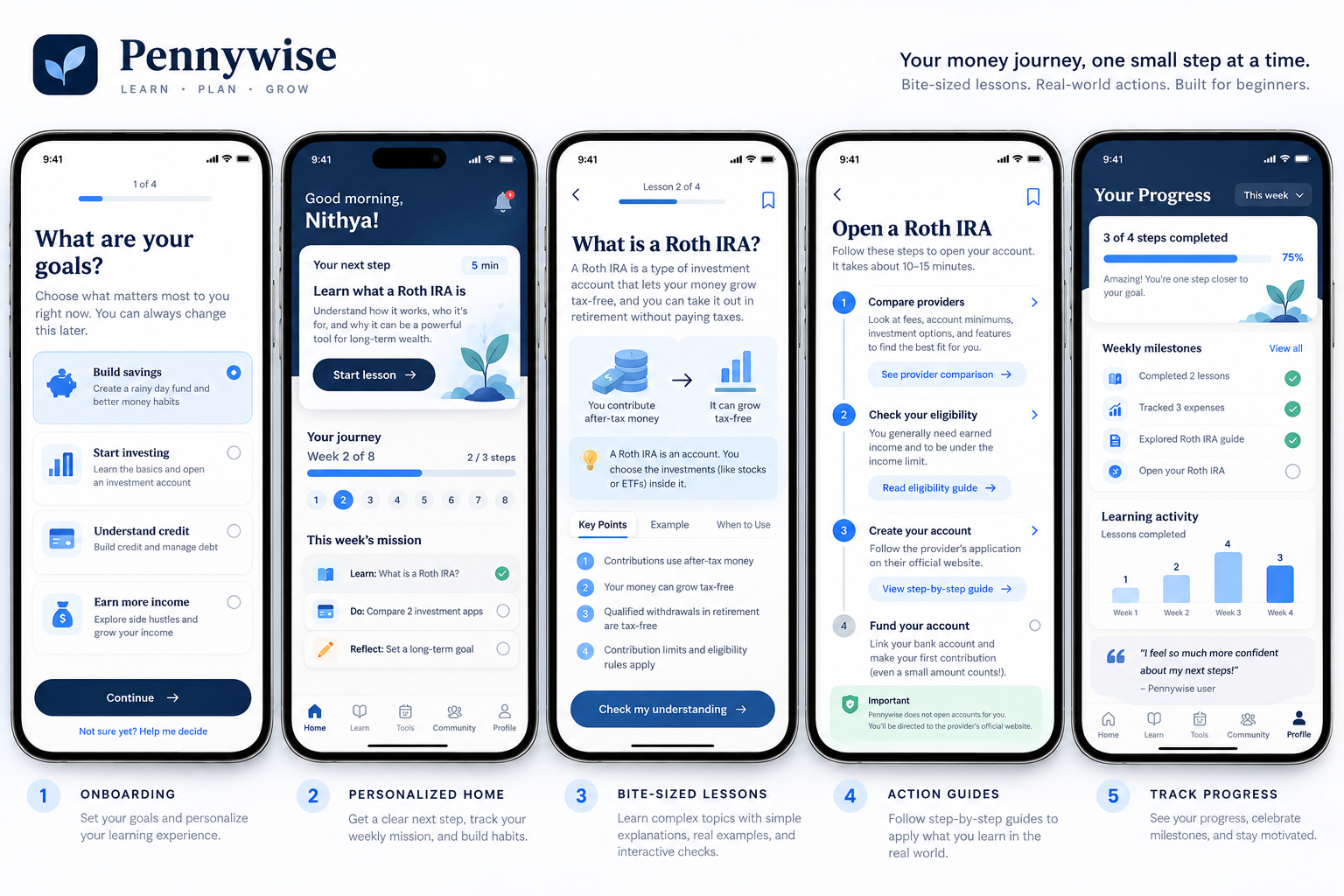
Pennywise
A financial learning companion that turns overwhelming money advice into one small, achievable action at a time.
Read the story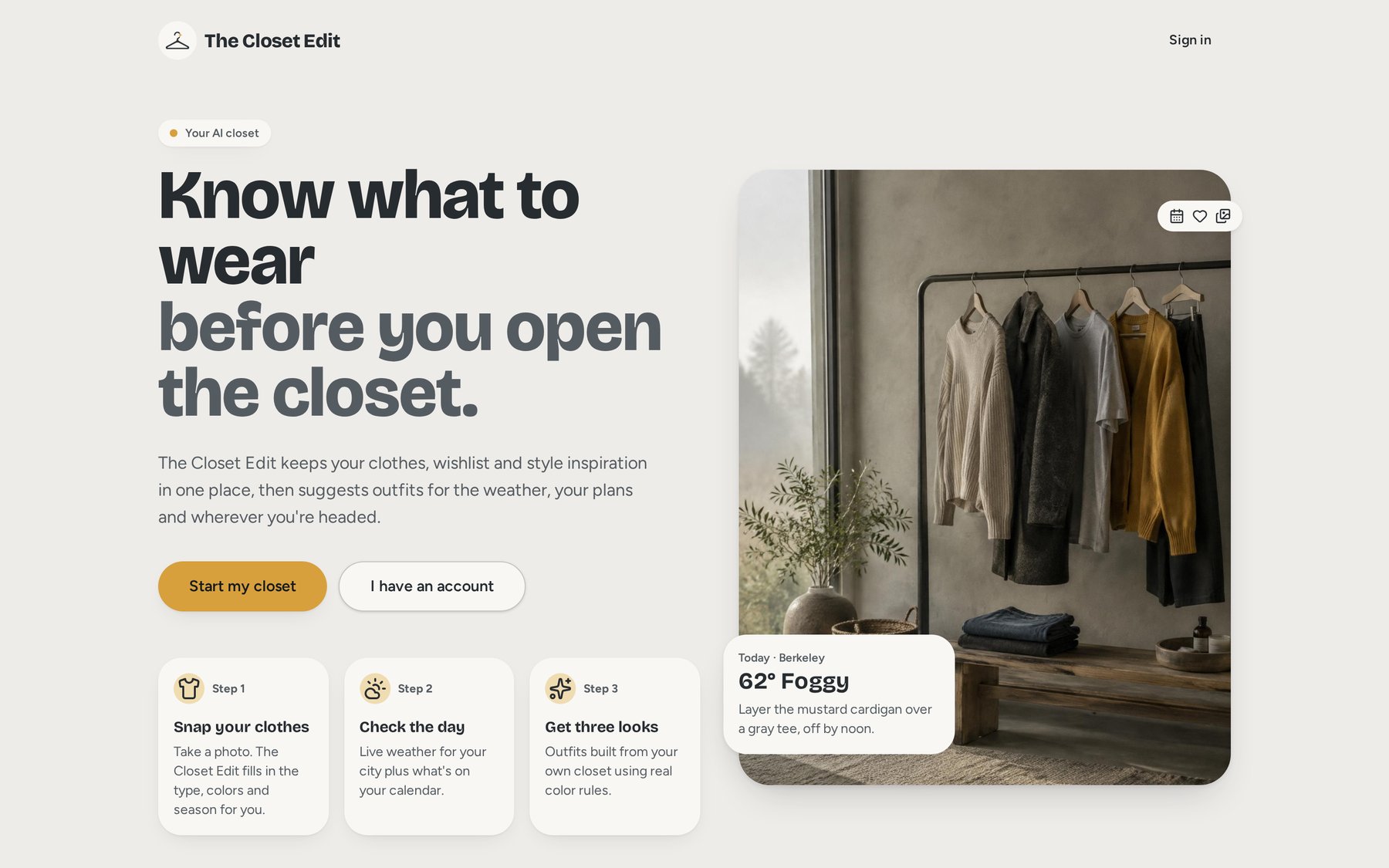
02 / AI product / Consumer2026
The Closet Edit
An AI stylist that plans outfits from the clothes you already own, shaped by a 112-person survey.
Read the story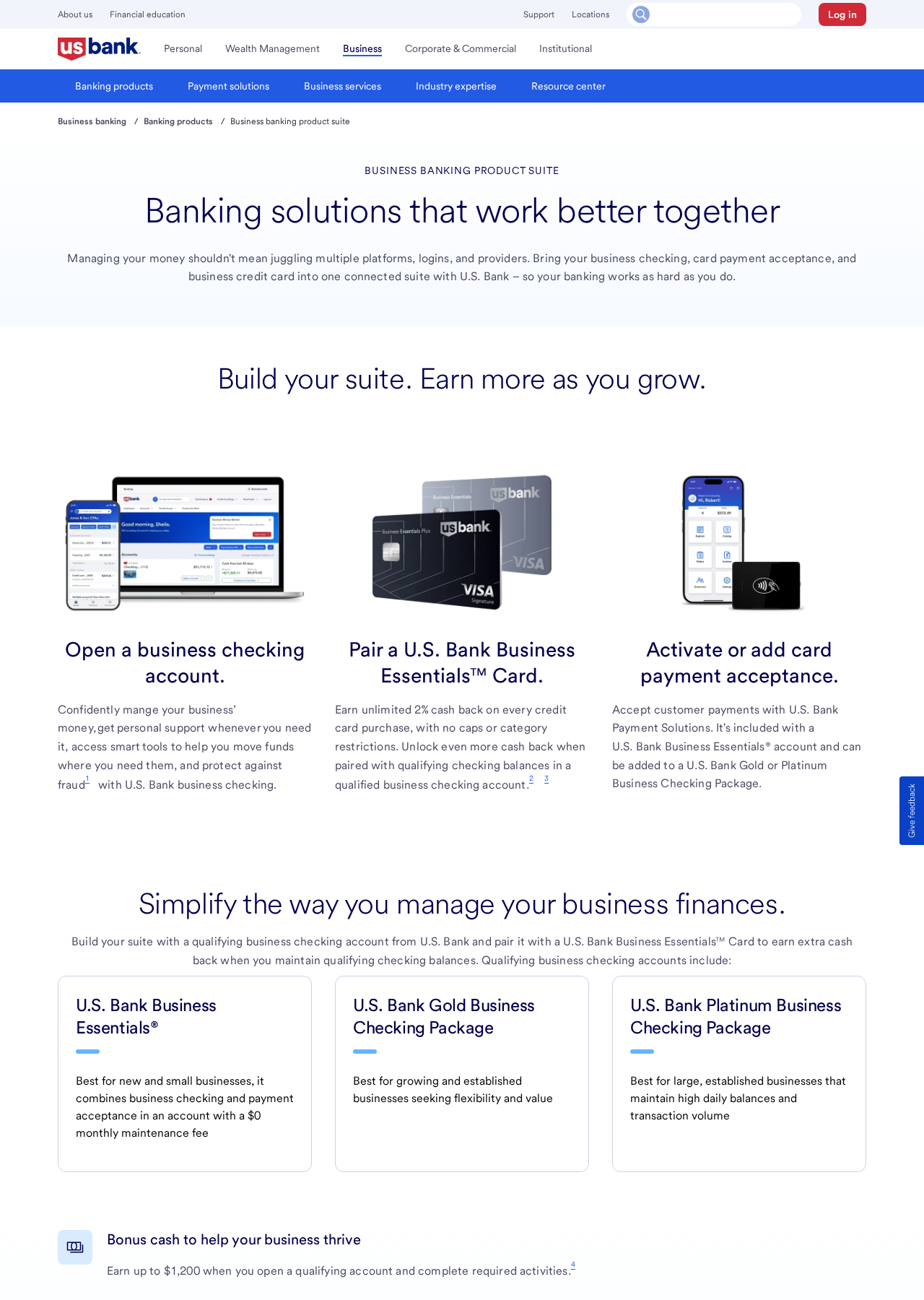
03 / Business banking / Product launch2026
U.S. Bank
Translating a complex banking bundle into a clear customer decision.
Read the story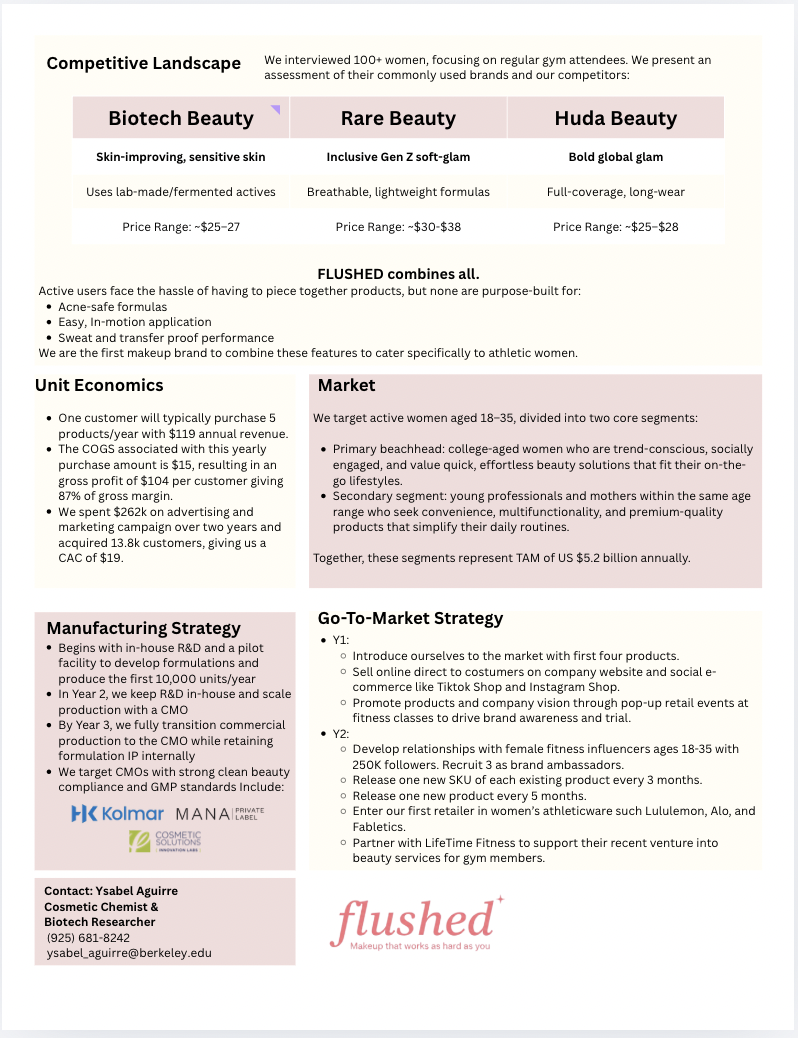
04 / Early discovery / Product direction2025
FLUSHED
Makeup for the gym and beyond, shaped by 100+ customer conversations.
Read the story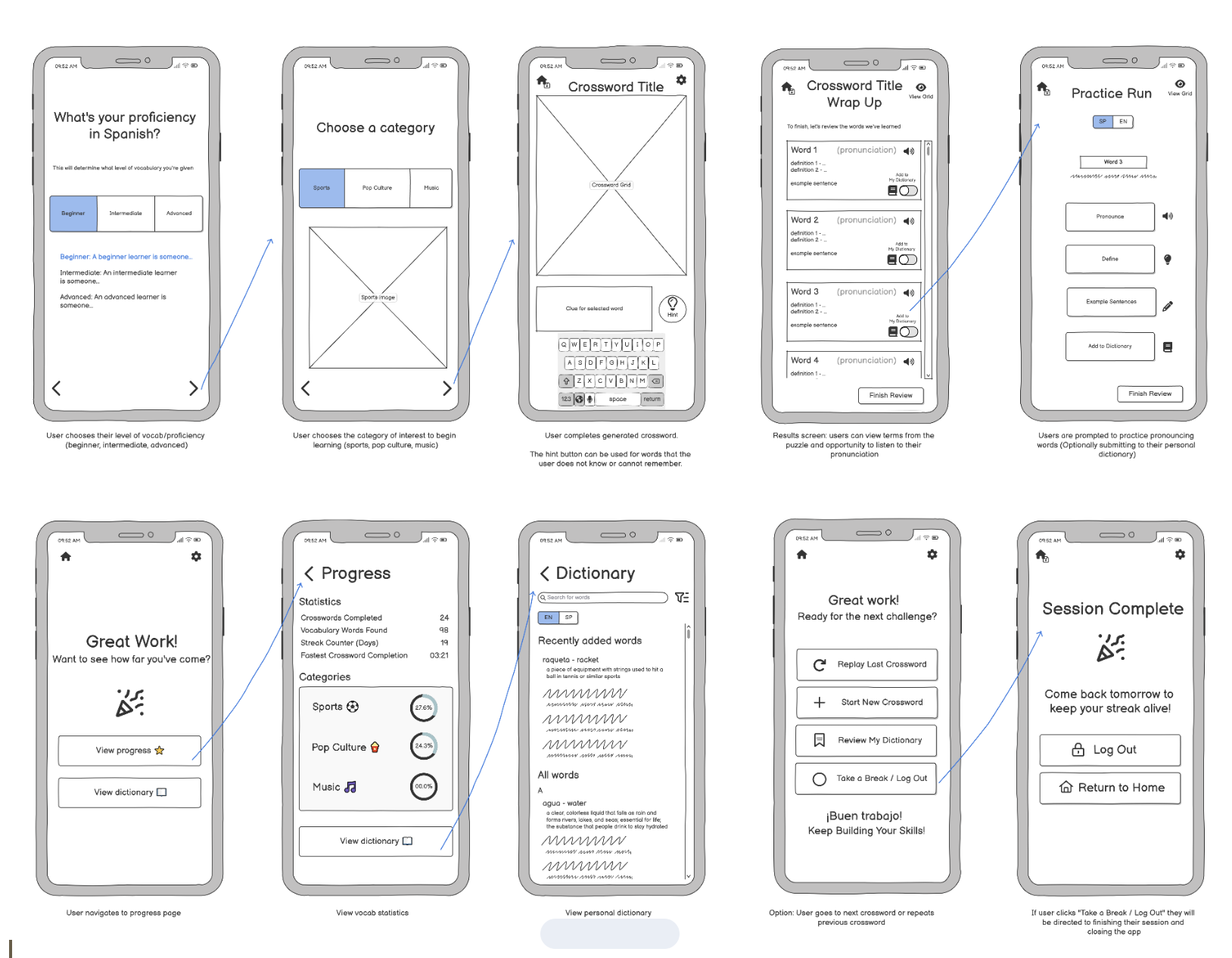
05 / Experience design / Learning2025
CrossLang
Turning language practice into an interest-led, repeatable ritual.
Read the story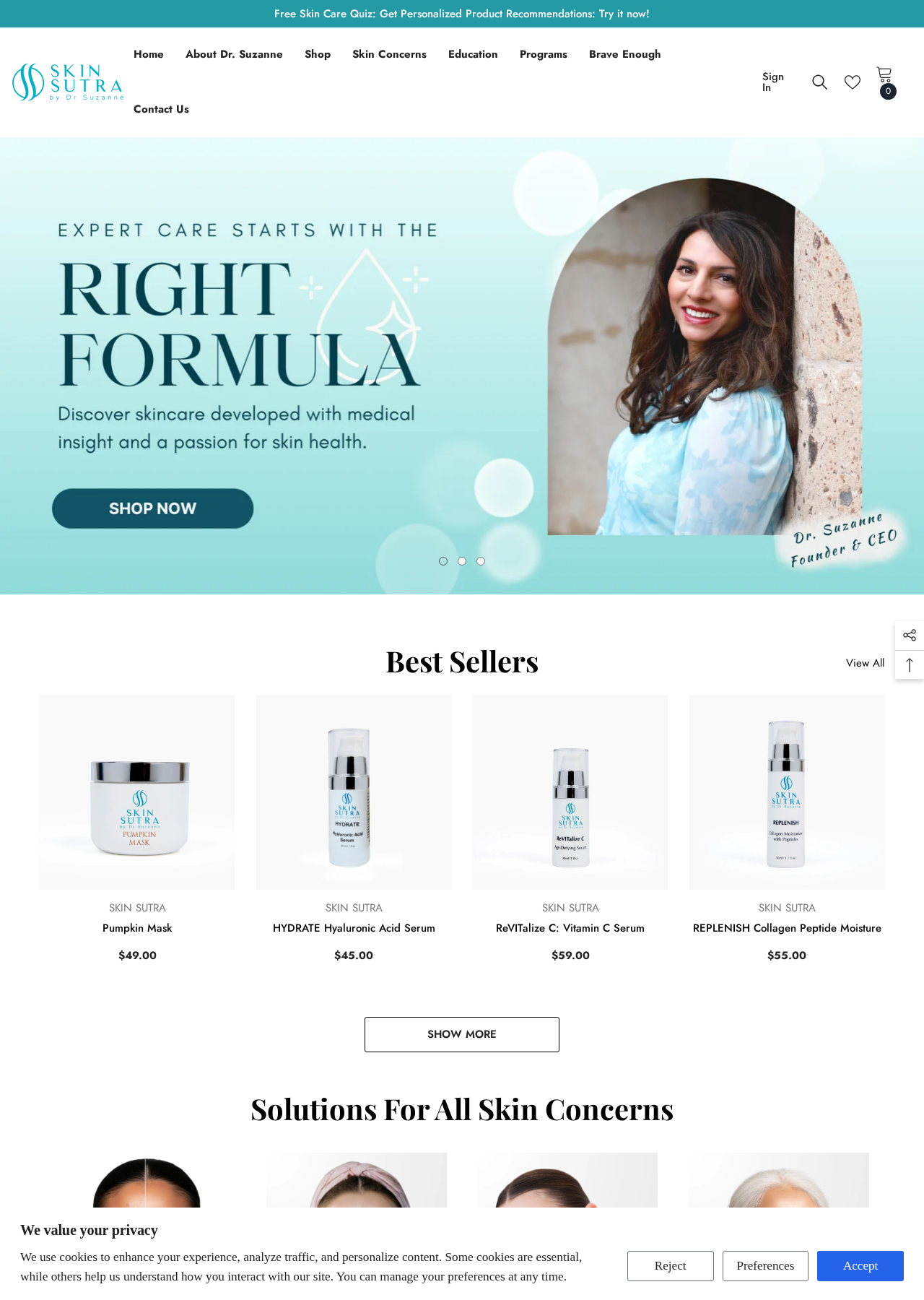
06 / Commerce / Customer experience2024
Skin Sutra
Connecting education, concerns, and commerce; purchases rose 40% after the recommendation launch.
Read the story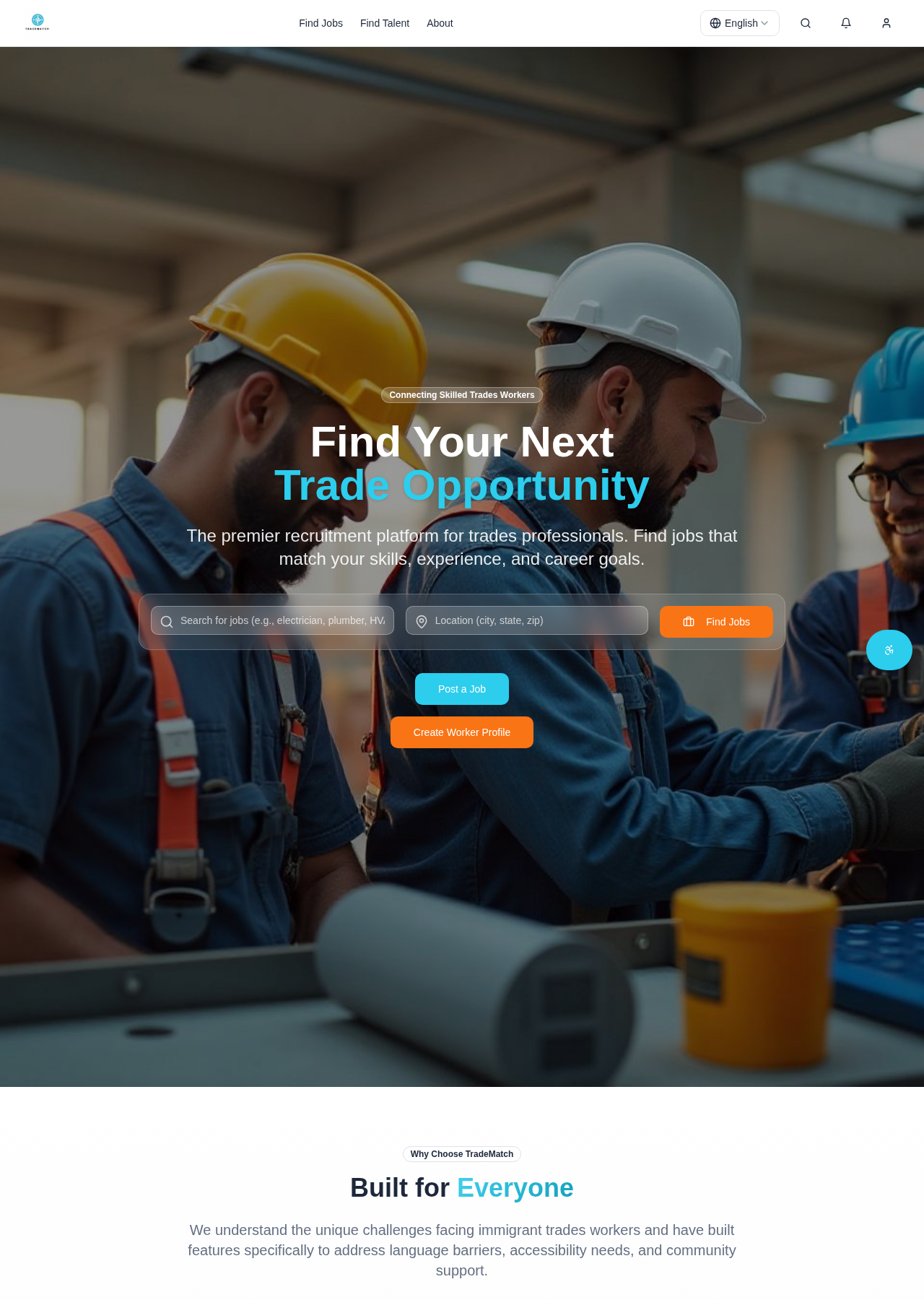
07 / Marketplace / Product strategy2024
TradeMatch
1st place winner. Making skilled-trades hiring more accessible, starting with 150+ conversations.
Read the storyPennywise
Making financial literacy actionable, one small step at a time.
Independent product concept: product strategy, MVP prioritization, PRD and experience design
Problem framing, product strategy, MVP scope, experience loop, success metrics
PRD and initial experience defined; in ideation, validation next
The problem.
Learning about personal finance shouldn't feel like learning a new language. From budgeting and emergency funds to Roth IRAs and investing, information is everywhere, but beginners don't know what to learn, where to start, or how to act. The product question: how might we help financial beginners turn overwhelming information into small, achievable actions?
The gap isn't access to information. It's knowing what matters right now and having the confidence to act.
- Not another content library
- One principle: one meaningful money move at a time
A personalized learning companion for young adults managing money on their own for the first time.
- Learn: bite-sized, interactive lessons
- Act: practical guides for budgeting, saving and opening accounts
- Grow: weekly missions, progress tracking and gentle reminders
Prioritized four capabilities for v1:
- Personalized onboarding
- Bite-sized lessons to reduce cognitive overload
- Weekly missions that turn knowledge into behavior
- Progress tracking with reminders
- Deferred: AI assistance, account connectivity and advanced planning, to keep v1 focused, safer and easier to validate
Monthly Financial Progressing Users: people who complete a learning milestone and a real financial action within 30 days. Success is real-world action, not time in app.
- Onboarding completion
- First-action conversion
- Weekly mission completion
- Retention and financial confidence
What's next: validate the core hypothesis through user interviews, usability testing and a functional MVP. The most valuable product for a beginner might not give them more information. It might help them confidently take the next step.
Back to selected workThe Closet Edit
Know what to wear before you open the closet. Outfits from your own clothes, for today's weather, your calendar and the look you're going for.
Product owner: research, product decisions, design direction and testing.
User survey, MVP scope, feature set, visual identity, working web app, interview guide
112 survey responses · working MVP with AI outfits, closet, style board, wishlist and Google Calendar integration · 5 active users testing
What I heard.
Getting dressed depends on things that change every day.
- 34.8%decide based on the weather
- 26.8%decide based on plans or events
- 54.5%don't know how to style pieces together
- 50.9%spend 10+ minutes choosing an outfit
- 69.6%get inspiration from Pinterest
- 64.3%get inspiration from Instagram or TikTok
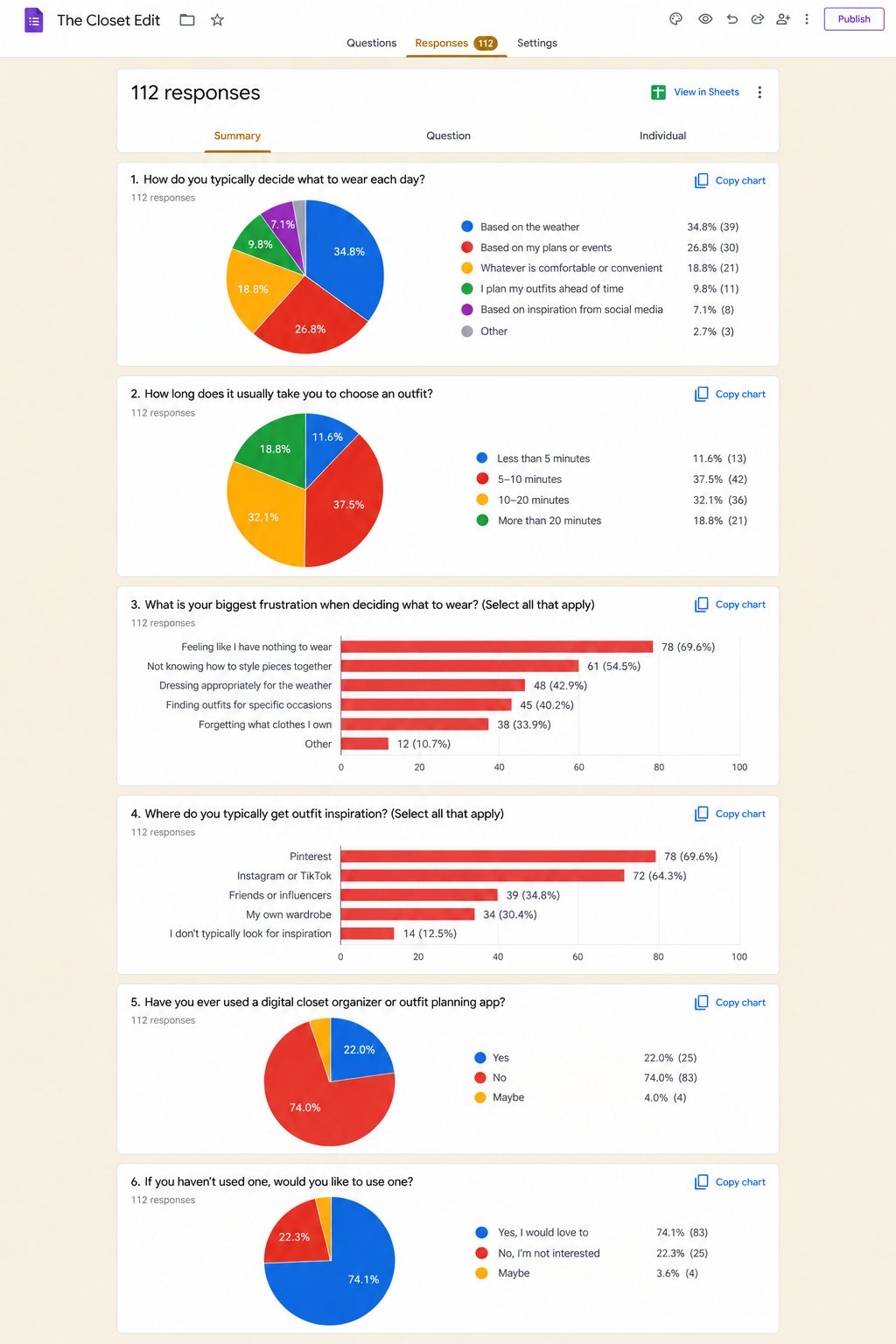
Most people own enough clothes. What they lack is a fast way to see what they own and put it together for the day ahead.
- Weather and plans drive most outfit choices
- More than half don't know how to style what they have
Four calls made before building:
- Anyone can sign up: a private closet and their own Google Calendar
- A photo is enough: AI fills in type, colors, fabric and season
- Pins are pasted or uploaded, so it works on day one without Pinterest approval
- A gender-neutral palette was used
Every survey finding mapped to a feature:
- Live Berkeley weather, morning to evening
- Google Calendar plus a "Where are you headed?" box for the occasion
- A stylist that follows color theory (60-30-10, analogous, complementary) and silhouette rules, and explains why each look works
- A style board for pins and screenshots
- A wishlist where missing pieces land in one tap
Polished the brand, copy and layout, then put it in front of real users. 5 people are actively using and testing the app now. Success means:
- They can use it without help
- They would wear at least 1 of the 3 suggested outfits
- They rate it 7+ out of 10
Page by page
Today
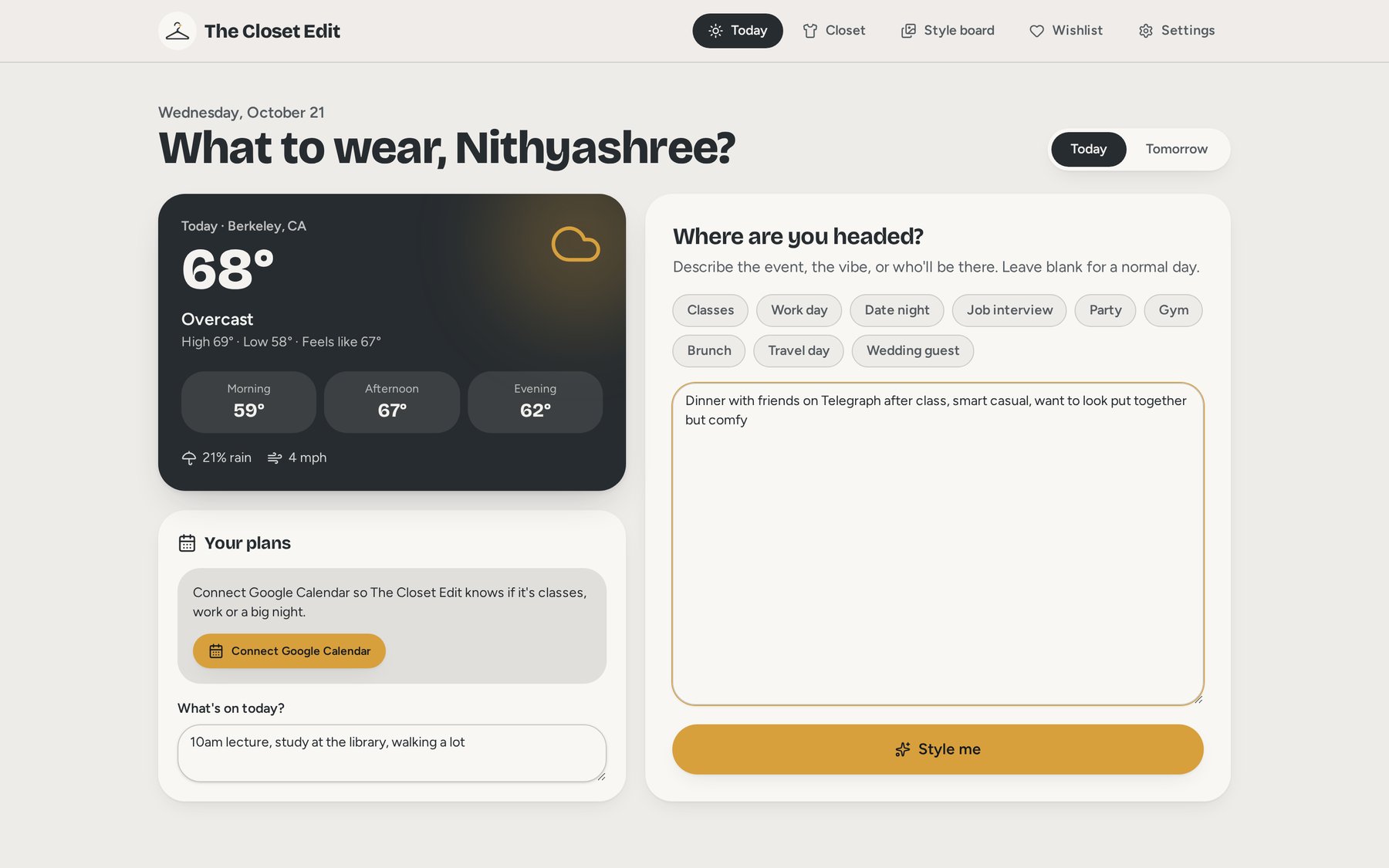
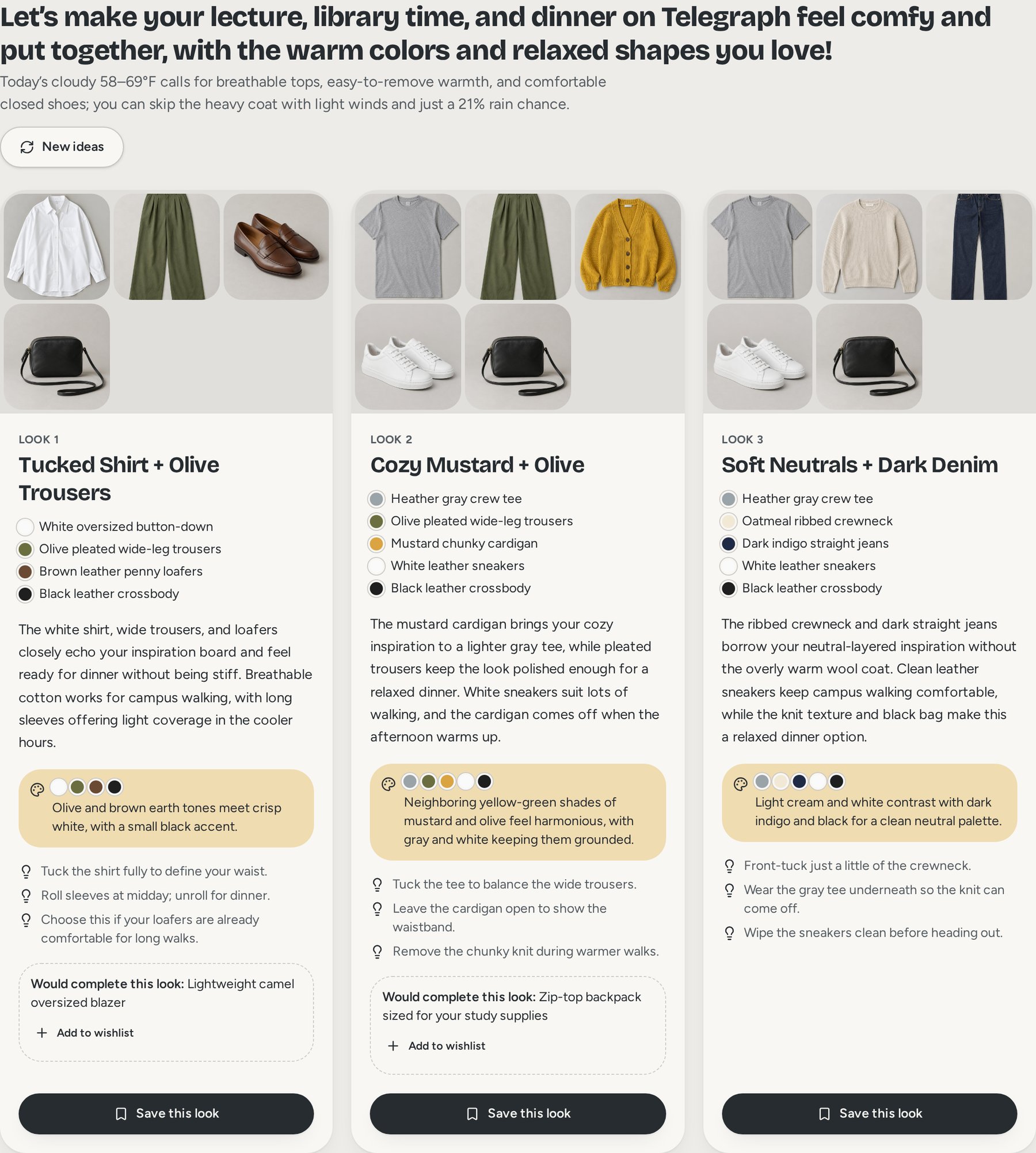
- Today / Tomorrow switch
- Weather card with high, low, feels-like and morning, afternoon and evening temps, rain and wind
- Plans from Google Calendar or typed in
- A "Where are you headed?" box with 9 quick picks
- A Style me button
- Results: 3 outfit cards, each with piece photos, why it works, a color story with swatches, styling tips, a "Would complete this look" piece to add to the wishlist, and Save this look.
Weather (34.8%) and plans (26.8%) drive most outfit choices, and 40.2% struggle with specific occasions, so all of it sits on one screen the stylist reads from.
Closet
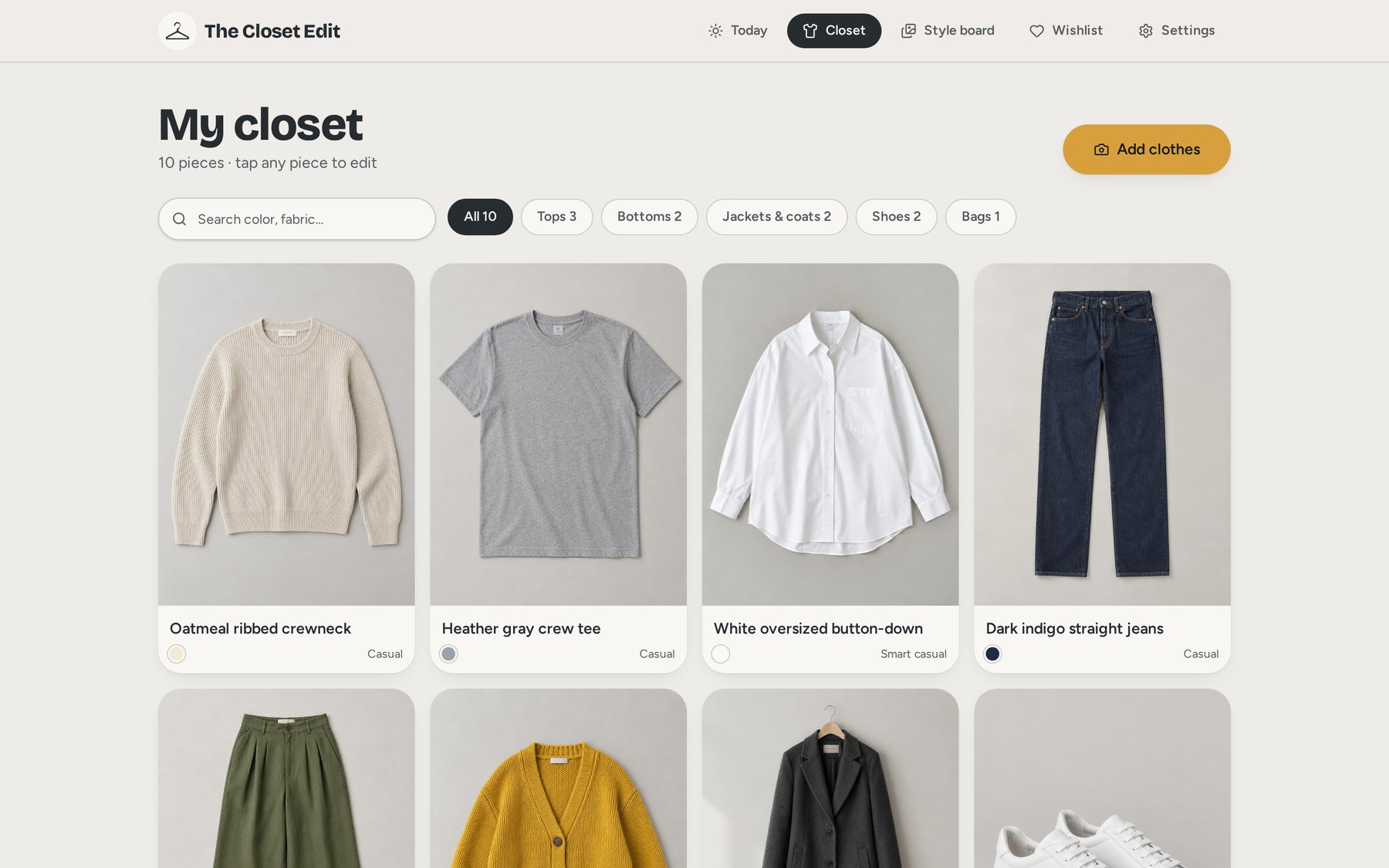
- Add clothes with a photo, the AI fills in name, type, dress level, colors, pattern, material, seasons and warmth
- Search by color or fabric
- Type filters with counts
- Every piece is editable.
69.6% feel they have nothing to wear and 33.9% forget what they own. Seeing everything fixes both, and a photo is enough so setup stays fast.
Style board
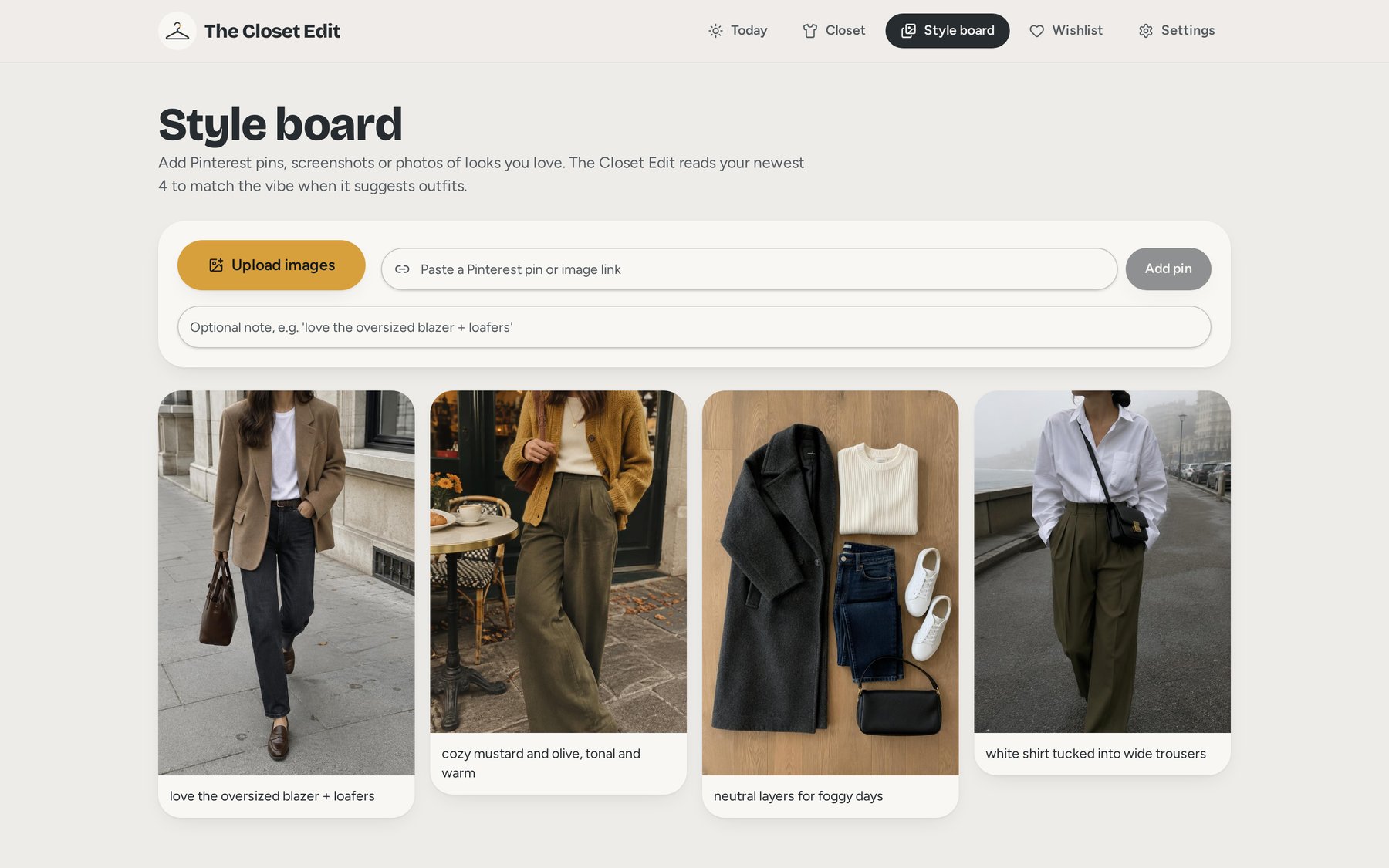
- Upload up to 12 images, paste a Pinterest pin or image link, add a note to each look.
Pinterest (69.6%) and Instagram or TikTok (64.3%) are where people get ideas. The stylist reads the newest 4 images and leans each outfit toward that look. Example: Look 1 "closely echoes your inspiration board" with a tucked white shirt and olive wide trousers, and suggested the camel blazer from the board.
Wishlist
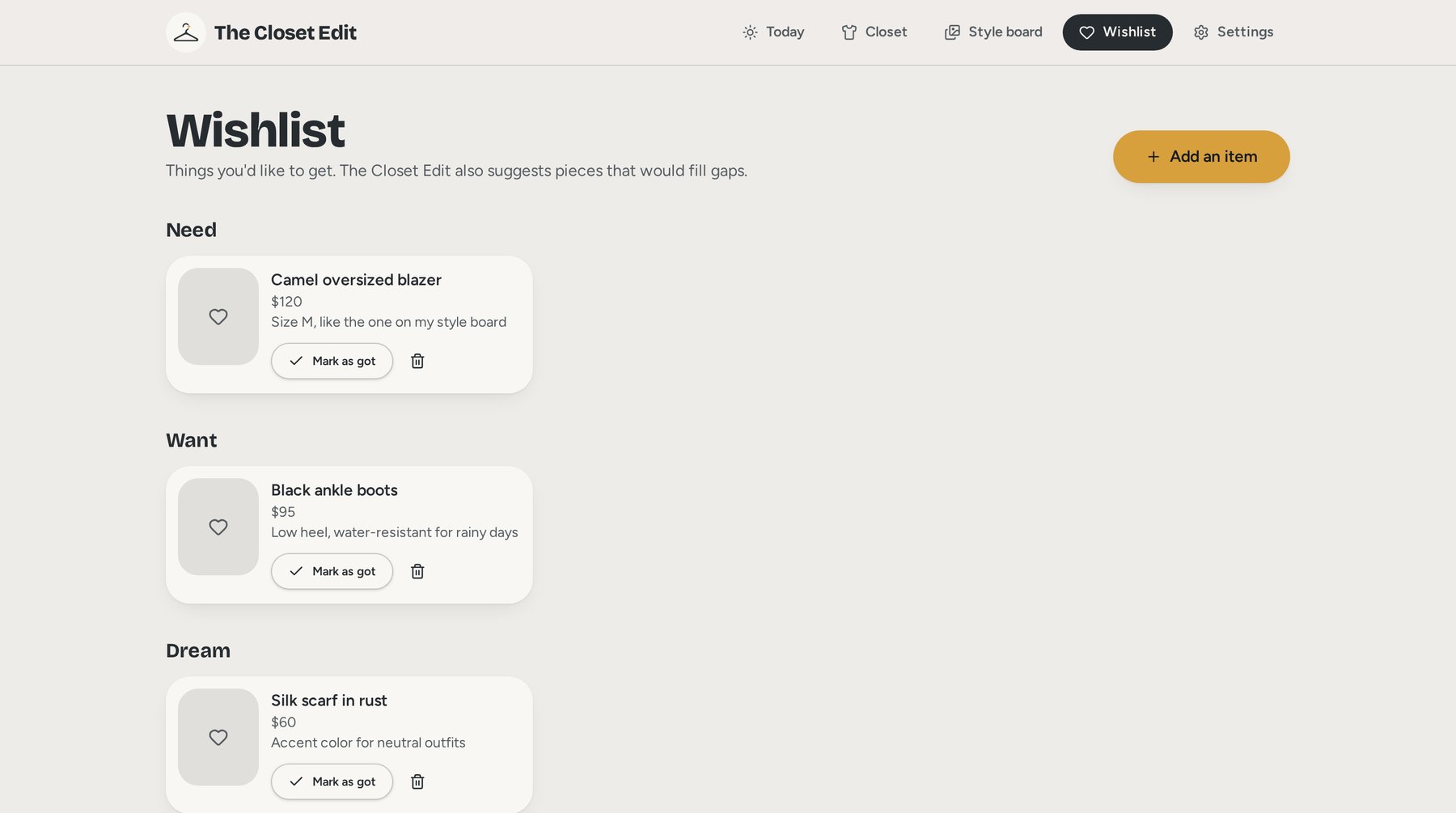
- Add items with Need, Want or Dream priority, link, price and notes
- Mark as got moves items to Got it and reminds you to add them to your closet
- The stylist's "Would complete this look" pieces land here in one tap.
Instead of buying more clothes that still don't go together, the wishlist keeps a short list of pieces that unlock more outfits from what you already own.
U.S. Bank
Make a bundle of banking products understandable to a business owner making a consequential decision.
Product Management Intern · Business Banking
Competitor research, user testing, prototyping, page design & content
50+ Jira epics as product owner; 18 prototypes supporting the September launch
Ran a competitive teardown of how peer banks present bundled products, which set the page's product story. Framed what business owners need to evaluate:
- What belongs in the suite
- Why the pieces work together
- What it costs them to choose
Supported usability sessions on the page experience.
- Translated findings into clearer content and design direction
- Helped visitors evaluate the suite without decoding internal product structures
Designed and wrote content for the Business Essentials suite page.
- 18 new prototypes in Microsoft Copilot, Figma Make and Claude to test components and page concepts
- A scannable hierarchy: the combined offer first, then each product easy to inspect
Partnered across product, design, engineering, CX and marketing to support the launch. As product owner for an offshore engineering team:
- Wrote 50+ Jira epics and user stories with acceptance criteria
- Prioritized the backlog and resolved cross-functional dependencies
- Used Dragonboat to support Q3 planning
- No conversion lift is claimed for this page
FLUSHED
Makeup made for the gym and after. One portable routine for everywhere the day goes.
Product strategy and go-to-market alongside two master’s students in chemistry and product development
User discovery, competitive positioning, product line, launch hypotheses
100+ women interviewed; concept-stage proposal, not launched sales
Start with the friction.
In the team's interviews with 100+ women, with a focus on regular gym-goers, the recurring need was not just longer wear. People wanted something that could survive sweat, feel skin-friendly, and be easy to reapply throughout the day. The opportunity was makeup that works during a workout and still fits the rest of the day. I worked with two master’s students in chemistry and product development to connect customer needs with formulation and format decisions.
Ran interviews and surveys with 100+ women, most of them regular gym-goers, and turned the findings into problem statements and design criteria.
- The job: makeup for working out that still looks and feels right afterward
- The recurring need was never just longer wear
Mapped the competitive landscape across biotech beauty, soft-glam and long-wear brands. The white space combines three things:
- Active performance
- Skin-conscious ingredients
- One-handed portability
Narrowed the first concept to three frequently used formats that fit a refillable keychain case.
- Lip balm, concealer and blush
- Glide-on sticks, precision tubes and pens
- Design principle: quick use, anywhere
Wrote launch hypotheses and a testable go-to-market plan. Manufacturing and unit economics are modeled assumptions to validate, not operating results.
- Direct-to-consumer
- Social commerce
- Creator partnerships
- Fitness pop-ups
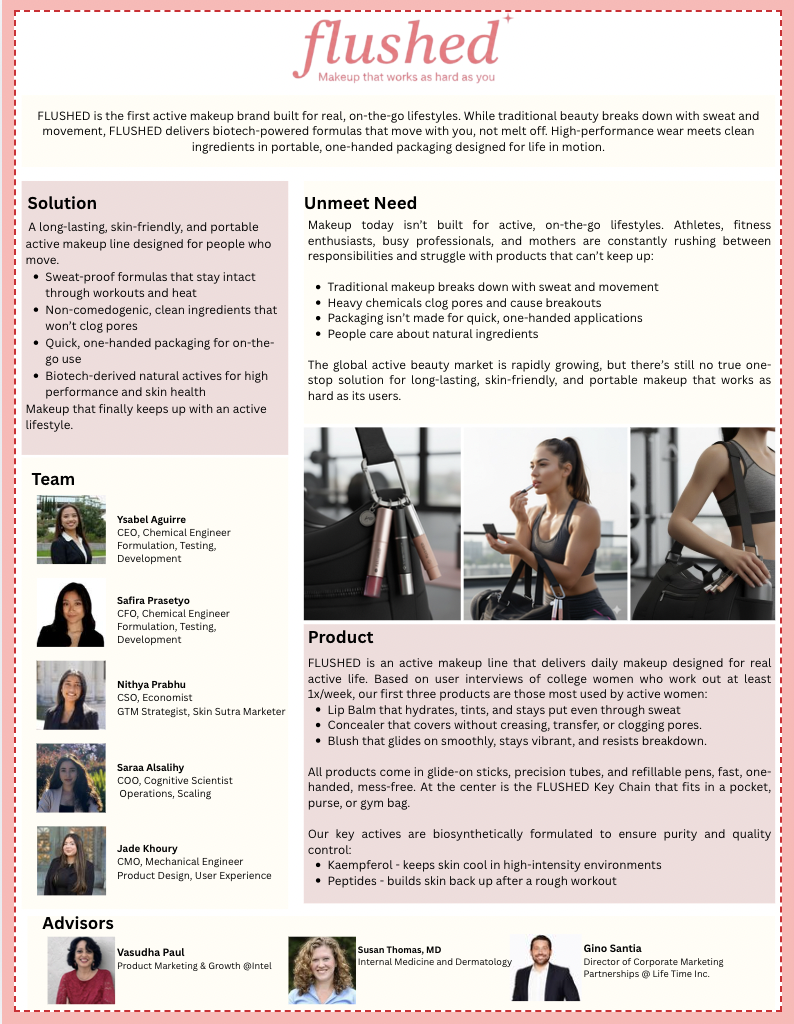
Product concept and forecast only. The board's market, cost, and acquisition figures are assumptions to validate, not achieved performance.
Back to selected workCrossLang
How might a language practice session feel small enough to start and rewarding enough to repeat?
UX research & experience design project
Journey mapping, onboarding, interaction flows, wireframes
Journey map and end-to-end wireframes; prototype, not a launched learning product
The core job: vocabulary practice in context, not another isolated word list. Applied cognitive load principles:
- Learners pick a proficiency level
- Learners pick an interest category
- Each crossword starts more relevant and lower effort
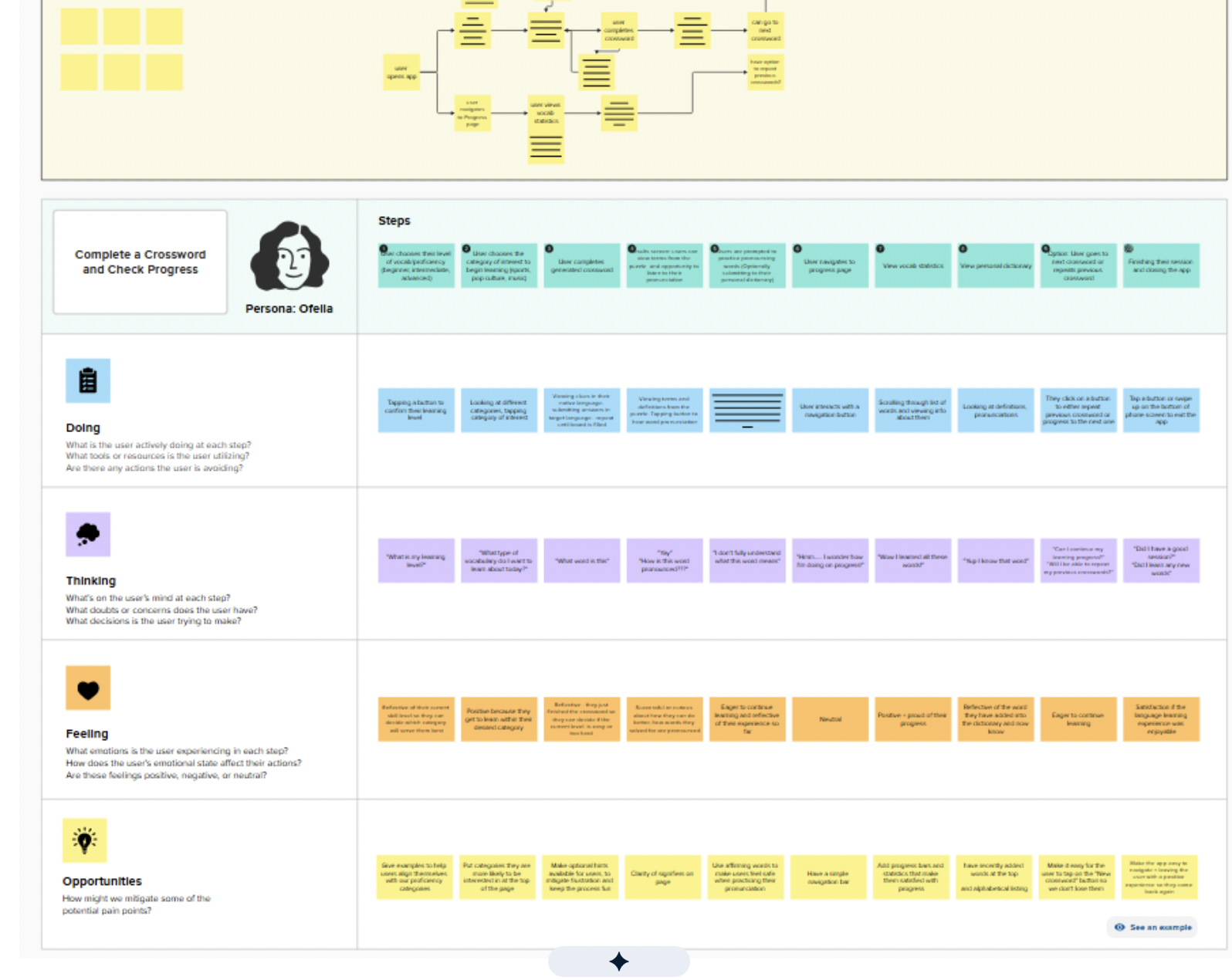
Built a journey map of what a learner does, thinks and feels, from picking a puzzle to checking progress. Two frictions shaped every screen:
- Unfamiliar words
- The momentum drop after finishing
Designed wireframes for the full loop, so each session makes the next one easier to start:
- Category selection and solving
- Reviewing clues and hearing pronunciation
- Defining and saving words to a personal dictionary
- Seeing progress
Habit loops that give learners a reason to come back. These are hypotheses in a prototype, not measured retention.
- Progress statistics
- Category completion
- A session-complete state
Skin Sutra
Help a customer move from “what is happening with my skin?” to an informed next step.
Product Management Intern · May 2024 to present
Education, Shop, Skin Concerns, recommendation experience, experimentation
Purchases +40%; subscribers +35%; organic traffic +35% per résumé
Redesigned the information architecture of Education, Shop and Skin Concerns around customer needs, instead of one generic catalog. Multiple paths in:
- Learn about a concern
- Browse solutions
- Get personalized guidance
Help shoppers understand the problem before choosing a product.
- Education and concern-led navigation build understanding
- The skincare quiz and recommendations narrow a broad need to a few relevant options
Authored the PRD for the AI-powered recommendation engine and partnered with engineering, design and marketing through launch.
- User stories and feature flows
- A KPI tree for conversion, engagement and retention
- Wireframes and user acceptance testing
Ran a hypothesis-driven experiment program and used GA4 and content analytics to prioritize the roadmap.
- +40% product purchases after the recommendation launch
- +35% subscribers and +35% organic traffic
- Dynamic-discount engine spec
- Pop-up and CTA A/B tests
TradeMatch
Make skilled-trades hiring work better for both the person looking for a job and the business trying to fill one.
Co-Founder & Chief Product Officer
Discovery, MVP prioritization, UX flows, PRD, go-to-market
1st place, BMOE Startup Competition · 150+ interviews · 80 early adopters
🏆 Won 1st place, Berkeley Method of Entrepreneurship Startup Competition
Interviewed 150+ trades workers and business owners and affinity-mapped the findings into the core opportunity.
- Job discovery
- Hiring friction
- Trust
- Accessibility
Turned research into wireframes, UX flows and a PRD, then ranked features by reach, impact and effort.
- Landed on five high-ROI features
- Product bet: make the first connection easier, across languages, before scaling the marketplace
Built and launched a multilingual website with lead capture.
- 80 early adopters onboarded
- An early demand signal, not yet proof of placements or scale
Built the go-to-market plan and pitch.
- Market sizing and competitive positioning
- A phased launch roadmap
- 1st place, Berkeley Method of Entrepreneurship Startup Competition
- SCET Collider Cup finalist